Work
Purgo AI
Designing retrieval and code review for a data-engineering agent
Purgo’s multi-agent LangGraph system turns a data team’s ticket into PySpark, SQL and dbt code. I designed its retrieval pipeline, chose the design by ablation on real tickets, and built several of the checks in its code review. With my dbt lineage step the agent missed about 70% fewer of the tables a ticket needs.
The agent’s stages - Analyze the ticket: Team’s
- Find candidate tables: Built
- Follow dbt lineage: Built
- Check against the warehouse schema: Built
- Rank candidates with an LLM: Reworked
- Draft a design: Reworked
- Write and review the code: Reworked
Testing LLMs and Databricks platforms for regulated use
I built two products end to end that life-sciences companies use to validate an AI model or a Databricks platform before they use it for regulated work. One tests an LLM for hallucination, consistency and bias against thresholds the customer sets. The other runs versioned tests on the customer’s workspace, with new tests drafted by an LLM from requirements documents.
The products’ parts - The product screens: Built
- The platform API: Reworked
- Two test engines: Built
- The customer’s Databricks workspace or model: Customer’s
- A report service renders the PDF: Built
- Signed in the app with embedded DocuSign: Built
Projects
ReadableSTEM
A tool that turns math and science PDFs, and LaTeX source, into web pages a screen reader can read. Two vision models read each equation, every reading is checked against the PDF’s own text layer, and the instructor decides anything uncertain. It is live as a free beta that anyone can sign in to.
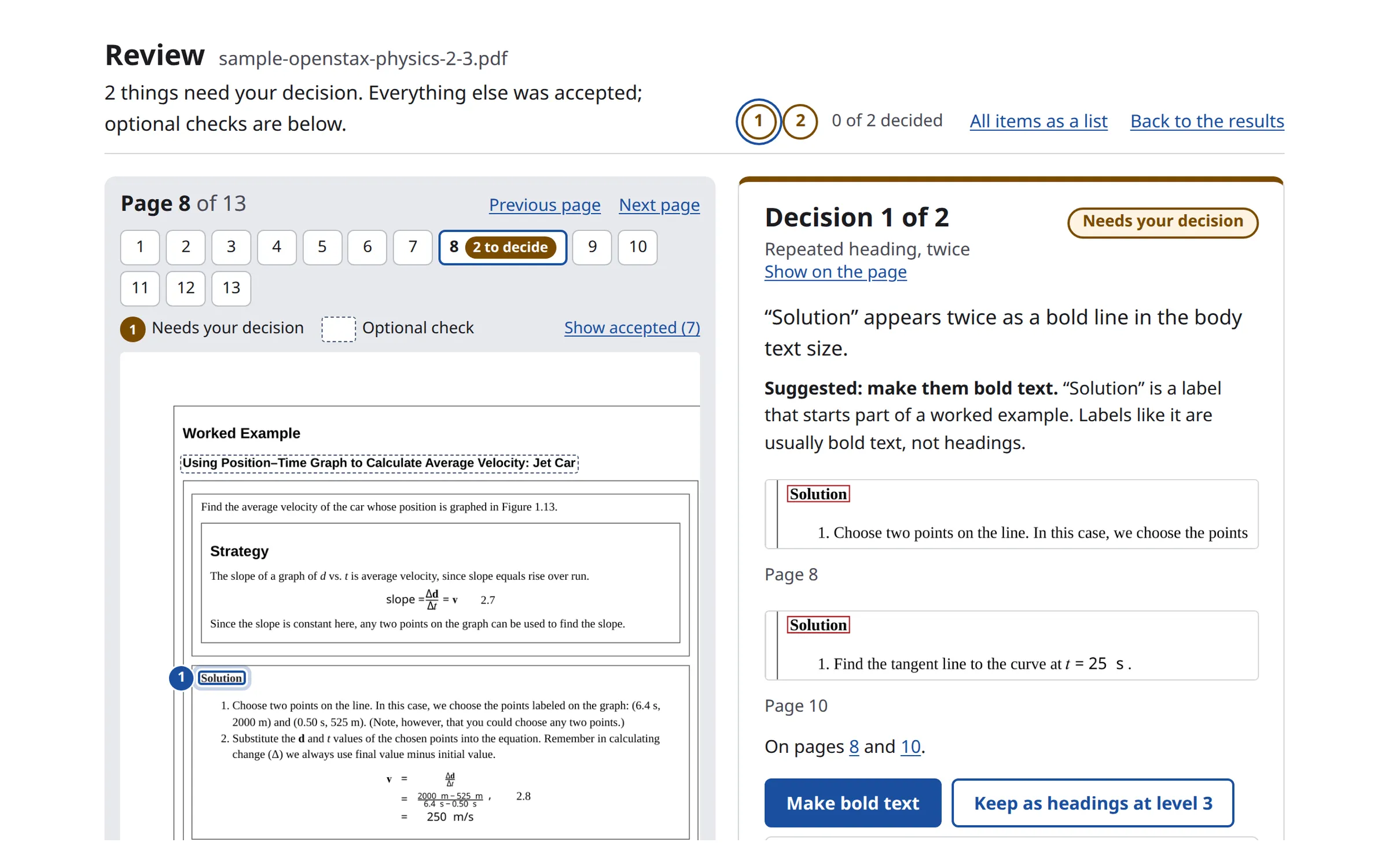
Evaluating ReadableSTEM with tests registered before they ran
I registered every test before any system ran. On 26 unseen documents ReadableSTEM matched a Claude Opus chatbot on equation accuracy at about a third of the cost, with about half as many silent errors (wrong equations with no warning). I report the bars it didn’t reach the same way.
ReadableSTEM against the Opus chatbot: what the registered tests measured - Equation accuracy
- about the same
- Cost
- about a third
- Silent errors
- about half as many
Margins
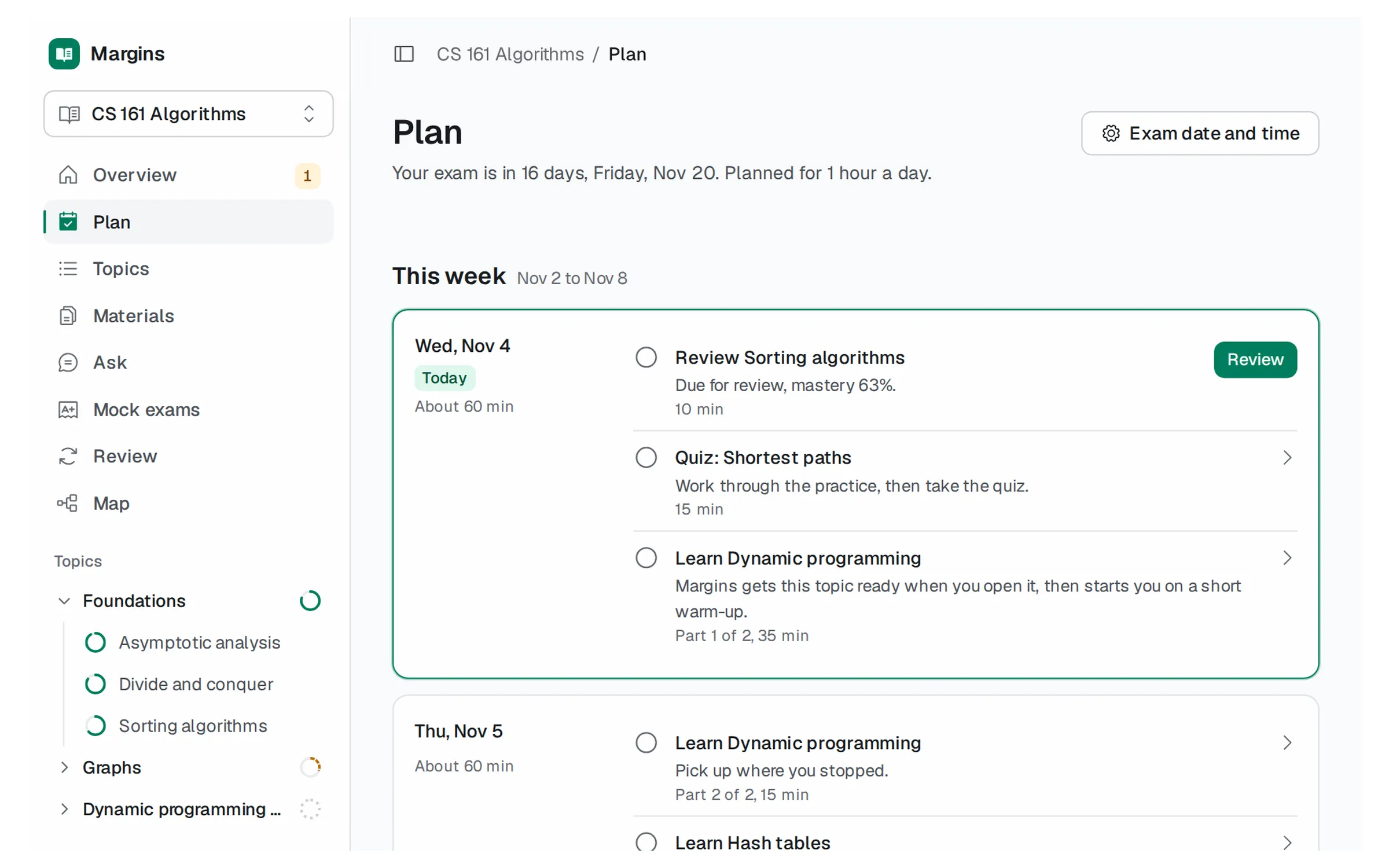
A study app that makes you try before it helps. The tutor’s hint level is enforced in server code, not left to the prompt, and every reply is screened for the answer before you see it. I test it with scripted students who push the tutor for the answer. Only answers you get right without help count toward mastery.
Holdbrief
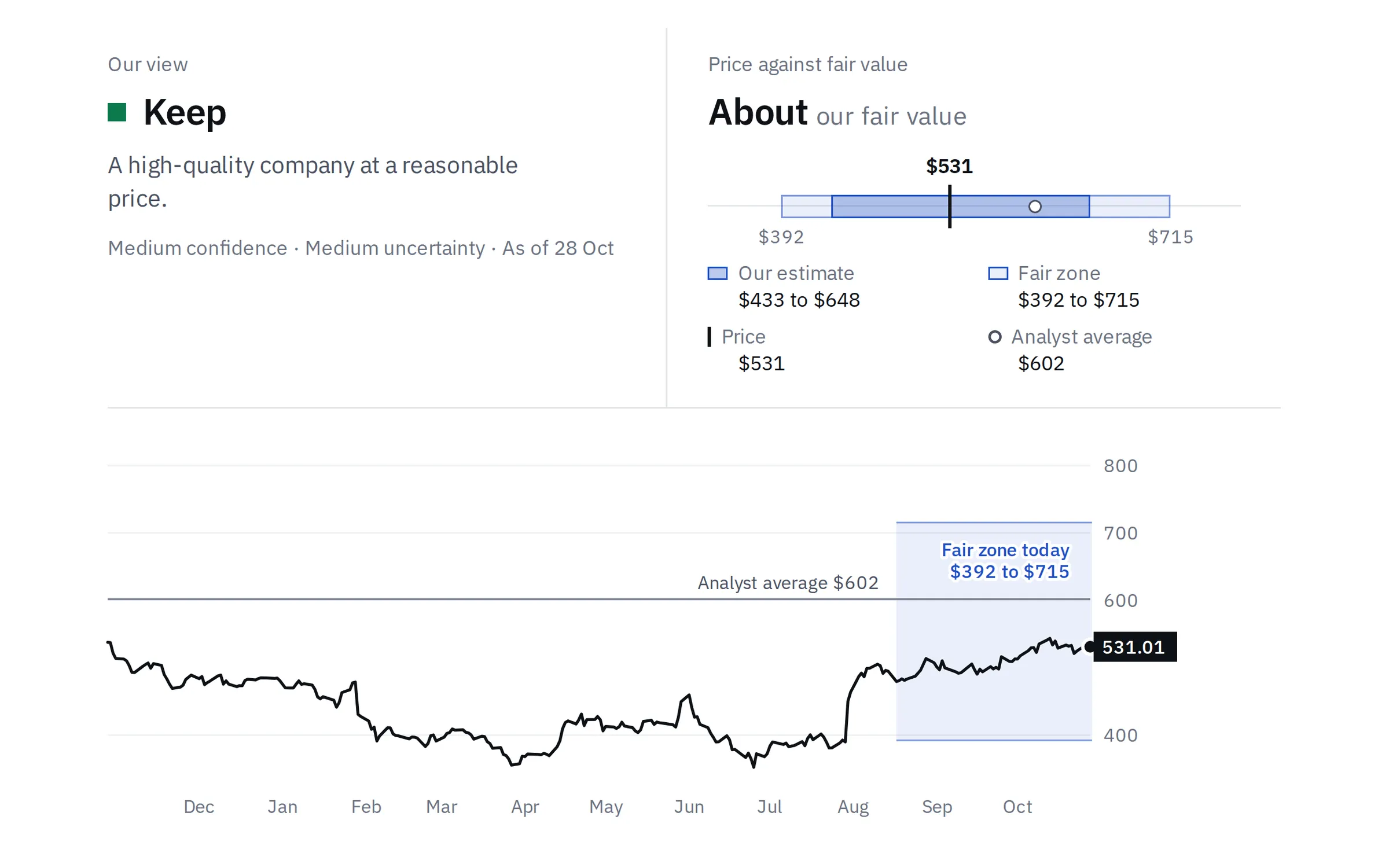
A daily brief on the US and Indian stocks you follow. Every number and every Keep, Watch closely or Reconsider call comes from fixed, versioned rules in code. An LLM writes the explanation from those facts, and a checker removes any sentence it can’t trace back to them. I store every published view and grade it later against the index.
Earlier internships
Digitus Business Solutions
I built four projects for the sales, support, legal and finance teams.
- Text-to-SQL agent that looks up the schema first and retries failed queries. Right answers rose from 52% to 76% on an internal set of 500 questions.
- RAG helpdesk assistant that cites documentation, videos and past tickets. Median time to resolution fell from 20 minutes to 6.
- Contract drafting and comparison tool with a reviewer in the loop. Legal review fell from 5 days to 2.
- Integration that sends signed invoices from the QAD ERP to Malaysia’s MyInvois tax system.
PwC India
I built demand forecasting (an XGBoost and SARIMA ensemble) and customer analytics for a client team. Forecast error (MAPE) came out 15% lower than the baseline across more than 50 products.
Research
Finding behaviors in mouse videos without labels
I segmented mouse videos into distinct behaviors for genetic analysis. A bidirectional RNN autoencoder learns a compact embedding of each stretch of pose-tracking data, and clustering groups similar stretches. Advised by Balaraman Ravindran and Vivek Kumar.
How microbes in homes support each other
I built metabolic models of the best-connected species in microbiomes from rural and urban homes and measured which species support which. Advised by Karthik Raman.
Coursework
Classified rank-maximal matchings
We presented a paper’s algorithm for matching applicants to posts as fairly as possible when posts come in nested groups with limits on each (rank-maximal matchings under laminar classifications), and its proof that the general case is hard.
Gene co-expression networks in COVID-19
We analyzed gene expression data with network and co-expression methods to find gene signatures linked to COVID-19.